



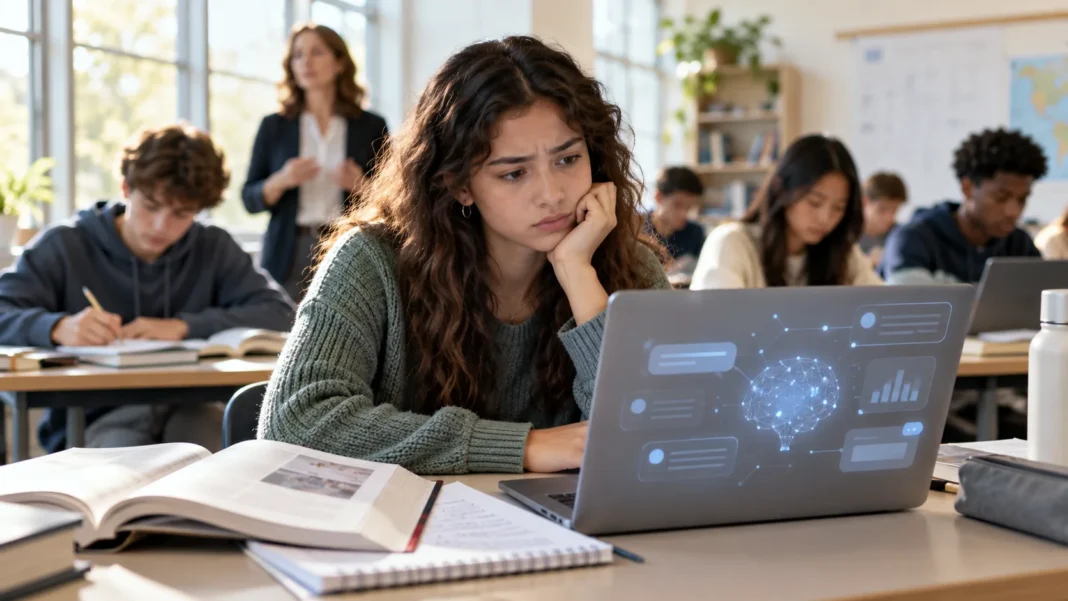
Understanding the Disadvantages of AI in Education
Artificial intelligence can help students brainstorm, review lessons, and get explanations outside class. It can also help teachers organize materials and adapt activities. But using AI in education brings risks that schools and families need to understand, especially when a tool is treated as a substitute for learning, human guidance, or reliable sources.
The five main disadvantages include weaker independent thinking, inaccurate information, academic integrity problems, privacy concerns, and unequal or biased outcomes. These risks do not affect every student in the same way, and they depend on how a tool is designed and used. Still, they matter whenever AI influences coursework or classroom decisions.
Understanding these drawbacks does not mean every AI tool should be avoided. It means students, teachers, and schools should use it with clear goals and sensible safeguards. The aim should be to support learning while protecting the skills, relationships, and fairness that education depends on.
1. AI Can Weaken Critical Thinking and Independent Learning
When students use AI to produce answers before trying a problem themselves, they may miss the reasoning that builds understanding. A completed essay, equation, or summary can look convincing even if the student cannot explain it. Over time, relying on instant answers may make it harder to start a task, evaluate ideas, or solve unfamiliar problems.
Learning involves more than reaching a correct answer. Students need to practice recalling information, testing possible solutions, recognizing mistakes, and revising their thinking. If AI performs those steps for them, the finished assignment may not reflect the student’s actual knowledge or show which concepts still need attention.
AI can be more useful when it asks questions or offers hints instead of completing the task. A student might request a simpler explanation, a similar practice problem, or feedback on their reasoning. This keeps the learner involved and makes the tool a study aid rather than a replacement for effort.
2. AI Can Provide Incorrect or Misleading Information
AI tools can generate statements that sound confident but contain errors, outdated details, or invented information. A response may mix accurate facts with unsupported claims, making the problem difficult to spot at a glance. Students who copy an answer without checking it may learn the wrong material or include false information in an assignment.
This risk matters in subjects where details need to be precise. A mistaken date in history, a faulty explanation in science, or an incorrect step in mathematics can lead to confusion. Even a summary of a real source can leave out an important qualification or make the author’s point seem stronger than it was.
Students should check important claims against textbooks, class notes, and trustworthy sources. They can ask an AI tool to show its reasoning, but that explanation also needs review. Comparing the answer with original materials teaches students how to verify information instead of relying on fluent wording.
3. AI Can Make Academic Integrity Harder to Protect
Generative AI can produce essays, discussion posts, answers, and other work that students may be tempted to submit as their own. This creates problems for teachers trying to understand what a student knows. It can also be unfair to classmates who complete their assignments without generating the core work through a tool.
Schools and instructors may have different rules for AI use. One assignment might permit brainstorming but not generated paragraphs, while another could allow editing with disclosure. When students do not understand the boundary, they may break a class policy without realizing it or misrepresent how their work was created.
Clear guidance can reduce uncertainty. Teachers can explain which uses are acceptable, whether students need to disclose AI assistance, and what parts of an assignment must be completed independently. Students should keep their own notes and drafts, and be ready to explain the ideas and sources in their submitted work.
4. AI Tools Can Create Student Privacy Concerns
Students may share more information with an AI tool than they intend. Prompts or uploads can include names, grades, personal circumstances, classroom discussions, or unpublished work. Before sharing this material, students should understand what information is collected, how it may be handled, and whether the school has rules about approved tools.
Privacy risks can be more serious when students are minors or use school-managed accounts. A student might upload a document containing information about classmates or a teacher without permission. Even if a platform offers useful features, the convenience of a quick summary does not automatically make every file appropriate to share.
Schools can help by choosing tools carefully and teaching students to remove personal details from prompts. Students should avoid entering passwords, contact information, private messages, or sensitive records. When the status of a document is unclear, they can ask a teacher before uploading it.
5. AI Can Reinforce Bias and Unequal Access
AI systems learn patterns from data, and those patterns may reflect social or cultural bias. As a result, a tool might give less relevant examples to some students, interpret language differently across dialects, or produce stereotyped descriptions. If educators rely on such outputs without review, biased material can enter lessons or assessments.
Access is another concern. Students may have different internet connections, devices, paid subscriptions, language support, or opportunities to learn how AI works. If some students can use powerful tools while others cannot, AI-based assignments may reward access and familiarity as much as subject knowledge.
Schools should review AI-generated learning materials and offer alternatives when students cannot use a particular tool. Teachers can check examples for assumptions, missing perspectives, and uneven treatment. Designing assignments that do not require paid AI access helps keep expectations fair for students with different resources.
AI Can Change the Role of Teachers and Human Feedback
AI can provide quick explanations and automated feedback, but it does not know every student’s background, classroom dynamics, or personal needs. A teacher can notice confusion, ask a follow-up question, and adjust an explanation based on what a student says. A tool may respond quickly while still missing the reason a learner is struggling.
If schools use AI mainly to reduce human contact, students may lose valuable interaction. Discussion, encouragement, debate, and individualized guidance all contribute to education. A chatbot can help with practice, but it cannot fully replace the judgment and relationships that teachers bring to a classroom.
Teachers can use AI for preparation or routine support while keeping important educational decisions under human review. For instance, a tool may suggest quiz questions, but the teacher should check their accuracy and fit. Human oversight helps ensure that classroom materials and feedback reflect learning goals and student needs.
How Students Can Use AI Without Losing Learning Skills
Students can begin by attempting a task before asking AI for help. Writing an initial answer, showing their own working, or listing what they already understand makes it easier to see where they are stuck. Then they can request a hint or explanation focused on that specific gap.
Use AI to practice rather than to skip practice. Ask it to create questions, explain why an answer is incorrect, or give a new example using the same concept. After reviewing the response, close the tool and explain the idea in your own words to check whether you can recall it independently.
Keep a record of how AI contributed to major assignments when class rules require disclosure. Save source links, rough drafts, and important prompts so you can retrace the work. These habits support academic honesty and help students take responsibility for the final result.
What Schools and Teachers Can Do to Reduce AI Risks
Schools can set clear policies that explain acceptable AI use in plain language. Students should know whether they can use AI for brainstorming, research, grammar feedback, or drafting, and whether they need to acknowledge that use. Clear examples are often easier to follow than a broad rule that simply says “use AI responsibly.”
Teachers can design assignments that make student thinking visible. In-class discussions, drafts, reflections, oral explanations, and personalized prompts can show how a student developed an idea. These methods also give learners a chance to receive feedback during the process instead of being judged only on a polished final document.
Training matters for educators as well as students. Teachers need time to evaluate tools, recognize possible errors or bias, and protect student information. Schools can start with limited, purposeful uses and review whether those uses actually help students learn before adopting AI across many subjects.
How to Keep AI in Education in Perspective
AI is one tool within a larger learning environment that includes teachers, classmates, books, experiments, and personal effort. It can help with certain tasks, but convenience is not the same as educational value. A tool is useful when it helps students understand, practice, or improve work in ways that match the lesson.
The best measure is what students can do after using AI. Can they explain the topic, solve a similar problem, defend their argument, or identify a source? If they can only repeat the generated answer, the tool may have finished the task without supporting lasting understanding.
Schools should review AI use regularly because tools and classroom needs change. Students should also reflect on whether a tool is helping or making them more dependent. Keeping learning goals at the center makes it easier to choose when AI adds value and when it should be left aside.
Conclusion
The main disadvantages of AI in education include reduced independent thinking, inaccurate answers, academic integrity concerns, privacy risks, and bias or unequal access. These issues can affect students, teachers, and schools in different ways. They are important to consider whenever AI is used for learning or assessment.
AI can still support education when it is used with clear rules and human oversight. Students should verify information, protect private details, and use tools to practice rather than avoid the work. Teachers and schools can create fair policies and assignments that make student understanding visible.
Education depends on curiosity, effort, feedback, and trust. AI should support those parts of learning, not replace them. By using it carefully and reviewing its impact, students and educators can benefit from useful features while staying alert to the risks.
FAQs
What is the biggest disadvantage of AI in education?
A major concern is that students may rely on AI for answers instead of practicing the thinking and problem-solving that help them learn. Other risks include inaccurate output, privacy issues, and bias.
Can AI give students incorrect answers?
Yes. AI can produce convincing but inaccurate or incomplete information. Students should compare important claims with class materials and reliable sources before using them in assignments.
Does using AI for schoolwork count as cheating?
It depends on the assignment and the school’s rules. Some instructors allow brainstorming or editing but prohibit generated submissions, so students should check the policy and disclose AI use when required.
How can students protect their privacy when using AI?
Avoid sharing passwords, personal details, private messages, or sensitive school records. Check school guidance before uploading course documents, and remove identifying information whenever possible.
Can AI replace teachers in education?
AI can support practice and provide quick explanations, but it cannot fully replace a teacher’s judgment, classroom relationships, and understanding of students’ needs. Human guidance remains an important part of learning.