


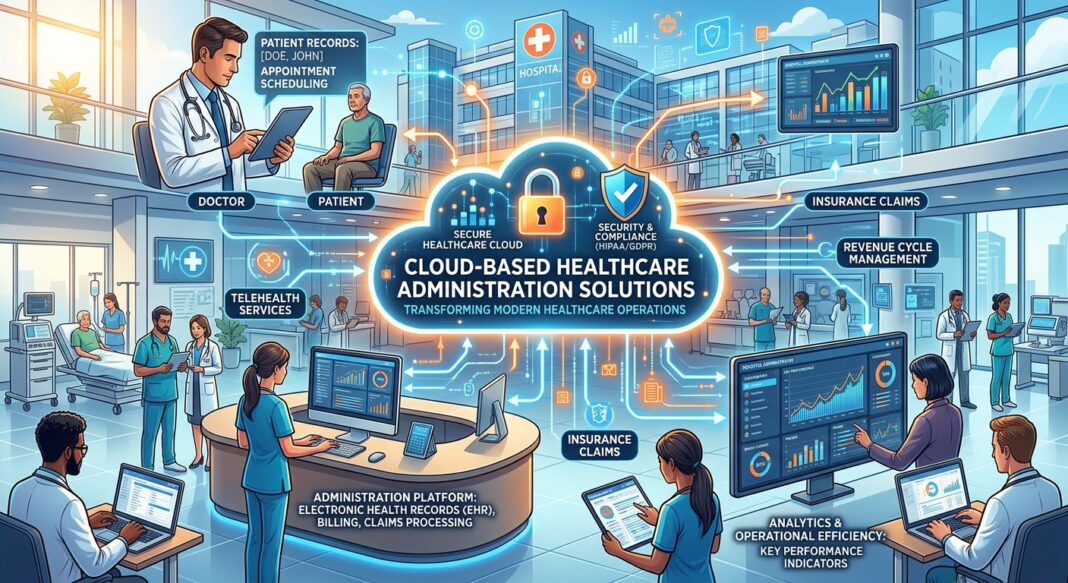
Healthcare organizations are increasingly turning to cloud technology to simplify complex administrative processes, improve operational efficiency, and deliver better service to members and providers. MCSI – Visova is one example, providing a cloud-native, HIPAA-compliant Platform as a Service (VPaaS) designed to support automated claims processing, enrollment, member management, premium billing, provider network management, capitation, and HRA/HSA integration. Its solutions help insurers, third-party administrators (TPAs), and provider networks streamline workflows and manage healthcare operations from end to end.
What Are Cloud-Based Healthcare Administration Solutions?
Cloud-based healthcare administration solutions are software platforms hosted in secure cloud environments rather than relying entirely on traditional on-premises infrastructure. They allow healthcare organizations to manage critical administrative functions through centralized, scalable systems that can be accessed by authorized users.
These platforms can connect multiple operational areas, including claims, membership, billing, provider information, enrollment, and financial administration. By bringing these functions together, organizations can reduce disconnected workflows and improve the flow of information across departments.
Cloud technology also makes it easier for organizations to scale their infrastructure as membership, claims volume, or administrative requirements change.
Simplifying Claims Processing
Claims administration is one of the most complex areas of healthcare operations. Insurers and TPAs must receive claims, validate information, determine eligibility, apply benefit rules, route claims appropriately, and calculate payment responsibilities.
A modern claim routing tool can help automate the movement of claims through appropriate processing workflows. Instead of relying heavily on manual intervention, claims can be directed according to predefined business rules, reducing unnecessary delays and helping administrative teams handle larger volumes more efficiently.
Cloud platforms can also support automated claims workflows by connecting claims data with eligibility, provider, benefit, and member information. This creates a more coordinated process from claim submission through final resolution.
The Role of Claims Adjudication
Claims adjudication determines whether a healthcare claim should be paid, denied, adjusted, or sent for additional review. Because adjudication involves numerous rules and data points, organizations can benefit significantly from automation.
Modern claims adjudication software can evaluate claims against eligibility requirements, benefit plans, provider information, pricing rules, and other relevant criteria. Automating these processes can reduce repetitive manual work while helping organizations apply rules consistently.
Cloud-based adjudication capabilities can also provide greater flexibility when healthcare organizations need to update business rules or adapt workflows to changing operational requirements.
Improving Enrollment and Member Management
Enrollment and member management are central to healthcare administration. Insurers need accurate information about who is covered, which plans members have selected, and when coverage begins or ends.
Cloud-based platforms can centralize member records and automate many enrollment-related processes. This can reduce duplicate data entry and help administrative teams maintain more consistent information across the organization.
A centralized system can also improve access to member information for authorized personnel, allowing customer service and administrative teams to respond to inquiries more efficiently.
Premium Billing and Financial Administration
Premium billing introduces another layer of complexity for insurers and healthcare administrators. Organizations must manage billing schedules, payments, adjustments, account information, and reconciliation.
Cloud-based healthcare administration platforms can integrate premium billing with enrollment and membership data. This connection helps reduce information gaps between coverage records and financial administration.
Automated workflows can also help organizations identify exceptions and streamline routine billing processes, allowing staff to spend more time addressing complex cases instead of repetitive administrative tasks.
Provider Network Management
Healthcare organizations must maintain accurate provider information and manage relationships across extensive provider networks. This includes information such as provider participation, contracts, specialties, locations, and network status.
Cloud-based provider network management can centralize this information and make it easier to maintain and update. When provider information is connected with claims and member administration, organizations can create more consistent workflows across different operational areas.
This integration is particularly valuable for insurers and TPAs managing large and changing provider networks.
Capitation and HRA/HSA Integration
Advanced healthcare administration platforms can also support specialized financial and benefit-management requirements.
Capitation involves predetermined payments to providers or healthcare organizations based on defined arrangements rather than individual services. Managing these arrangements accurately requires reliable data and automated administrative processes.
Similarly, integration with Health Reimbursement Arrangements (HRAs) and Health Savings Accounts (HSAs) can help organizations coordinate benefit-related information and administrative workflows. Bringing these capabilities into a broader platform can reduce the need to manage disconnected systems.
Benefits of Cloud-Native Healthcare Platforms
Moving healthcare administration to a cloud-native environment can provide several operational advantages:
- Scalability: Organizations can adapt technology resources as workloads and membership volumes change.
- Automation: Repetitive administrative processes can be handled through configurable workflows.
- Integration: Claims, enrollment, billing, provider, and member data can work together within connected systems.
- Accessibility: Authorized teams can access cloud-based applications without relying exclusively on physical office infrastructure.
- Operational efficiency: Automated processes can reduce manual data entry and administrative bottlenecks.
- Centralized management: Organizations can manage multiple healthcare functions through a unified technology environment.
- Flexibility: Cloud platforms can support changing business requirements and evolving healthcare processes.
Supporting End-to-End Healthcare Administration
The greatest value of a comprehensive cloud-based solution comes from connecting individual administrative functions. Claims processing should not operate independently from enrollment. Provider information should be available when claims are evaluated. Billing should correspond with accurate membership records.
A unified platform can create connections between these processes, giving insurers, TPAs, and provider networks greater visibility across their operations.
For organizations dealing with increasing claims volumes, complex benefit structures, and growing administrative demands, this integrated approach can help reduce operational friction while creating a more efficient foundation for healthcare administration.
Choosing the Right Healthcare Administration Solution
When evaluating a cloud-based platform, healthcare organizations should consider more than individual features. Security, regulatory compliance, scalability, integration capabilities, workflow automation, data management, and long-term flexibility are all important factors.
HIPAA compliance is particularly important when systems handle protected health information. Organizations should also evaluate how easily a platform can integrate with existing systems and whether it can support their specific administrative processes.
Ultimately, the right solution should help organizations move away from fragmented workflows and toward a connected operating environment.
Conclusion
Cloud-based healthcare administration solutions are reshaping how insurers, TPAs, and provider networks manage complex operational responsibilities. From claims processing and adjudication to enrollment, premium billing, provider network management, capitation, and HRA/HSA integration, cloud-native platforms can connect critical processes within a scalable and efficient environment.
Solutions such as MCSI – Visova demonstrate how a cloud-native, HIPAA-compliant Platform as a Service can help healthcare organizations automate workflows and manage operations more effectively. As healthcare administration continues to become more data-driven and complex, integrated cloud technology will remain an important tool for improving efficiency, consistency, and end-to-end operational management.