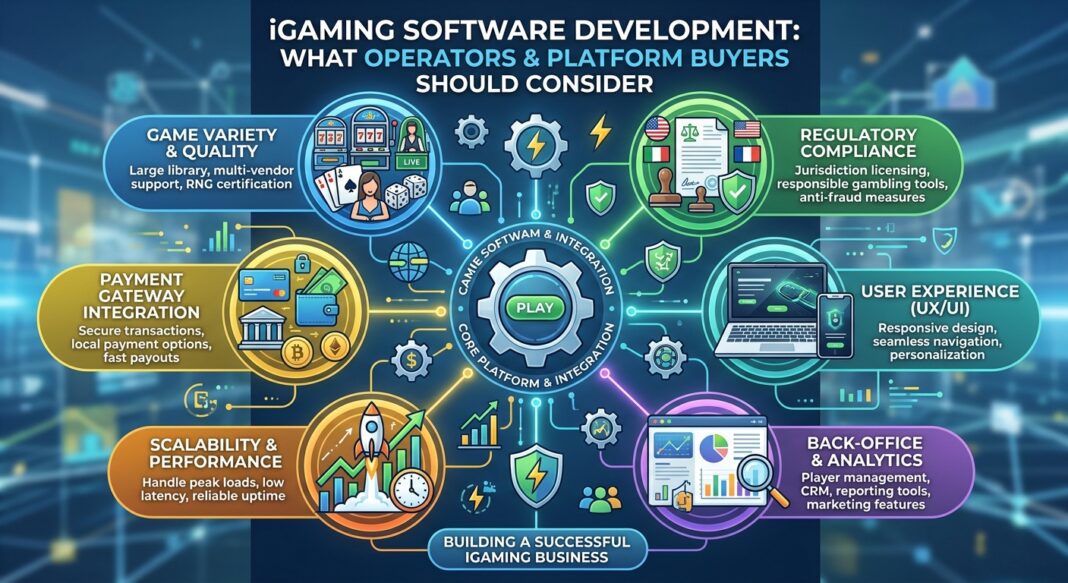
iGaming software development has become a core business consideration for operators that want greater control over their products, technology stack, and customer experience. Rather than treating software as a simple website or front-end interface, operators need to evaluate the entire platform behind the operation, including player management, payments, game integration, reporting, security, and operational tools.
For investors and platform buyers, the challenge is slightly different. The key question is not simply whether a system looks modern, but whether its architecture can support the intended business model, markets, suppliers, and future expansion. A well-planned technology foundation can make operational changes easier, while poorly selected software can create expensive dependencies.
Understanding the iGaming Software Stack
An iGaming platform typically consists of several interconnected components. The exact architecture depends on the operator’s product, target markets, suppliers, and technical strategy, but several functions are commonly required.
These may include:
- Player registration and account management
- Wallet and balance management
- Payment processing and transaction monitoring
- Game aggregation and content management
- Bonuses and promotional tools
- Back-office administration
- Reporting and analytics
- Customer support integrations
- Risk and fraud management
- Responsible gaming functionality
- API integrations with external providers
The important consideration is how these components work together. Adding functionality independently may appear convenient initially, but fragmented systems can create data inconsistencies and increase the technical workload required for maintenance.
Choosing Between Custom and Pre-Built Software
One of the first decisions for an operator is whether to develop a platform from scratch, use an existing turnkey solution, or combine proprietary components with third-party technology.
Custom development can provide greater control over workflows, user interfaces, integrations, and product differentiation. However, it also requires substantial planning, technical resources, testing, maintenance, and ongoing development.
Pre-built platforms can shorten the path to launch and provide established operational functionality. The trade-off is that operators may have less control over the underlying architecture and may become dependent on the provider’s development roadmap.
A hybrid model can be useful where an operator wants to retain ownership of important customer-facing or operational components while relying on specialist providers for selected infrastructure or content services.
The right choice should therefore be based on the operator’s business model rather than simply comparing development costs.
Why Integration Architecture Matters
An iGaming operation rarely runs on a single software product. Payment providers, game studios, identity services, analytics systems, CRM tools, affiliate platforms, and other services may all need to communicate with the core platform.
This makes API design and integration management particularly important.
A casino aggregator platform, for example, can provide a centralized connection between an operator and multiple game suppliers. Instead of developing and maintaining individual integrations for every provider, an aggregator can simplify content distribution through a common technical layer.
However, platform buyers should examine how integrations are actually handled. Important questions include:
- How are new providers added?
- How are game updates synchronized?
- How are technical errors monitored?
- What reporting data is available?
- How are provider-specific requirements handled?
- Can the operator retain sufficient control over game availability and configuration?
The number of available integrations is less important than the quality and manageability of those connections.
Building a Strong Player Management Layer
Player management is another central component of iGaming software development. The platform needs to handle account information, balances, transactions, bonuses, communication preferences, and relevant operational workflows consistently.
A strong player management system should also make information accessible to authorized operational teams without forcing them to work across disconnected administrative tools.
For platform buyers, usability is important here. A technically capable back office can still create operational problems if common tasks require unnecessary steps or if important information is difficult to locate.
Reporting should also be considered during development rather than added as an afterthought. Operators need access to useful operational information for monitoring activity, identifying issues, evaluating campaigns, and making business decisions.
Supporting Live Gaming Operations
Live gaming introduces additional technical requirements because the experience depends on continuous interaction between players, game providers, streaming infrastructure, and the operator’s platform.
Modern live casino solutions may require integration with live game providers, real-time game information, player interfaces, account systems, payment functionality, and operational monitoring.
The software architecture should therefore be assessed for how effectively it handles real-time communication and provider dependencies. Operators should also understand which components are controlled internally and which rely on external suppliers.
This distinction matters when troubleshooting. If a problem occurs during a live gaming session, identifying whether the issue originates in the operator’s platform, an API connection, streaming infrastructure, or the external provider can significantly affect response times.
Security, Testing, and Operational Resilience
Security should be considered throughout the software development lifecycle rather than treated as a final-stage feature.
Development teams should establish appropriate controls around authentication, authorization, sensitive information, APIs, administrative accounts, and payment-related workflows. Regular testing can help identify weaknesses before they become operational problems.
Testing should cover more than the player-facing website. A comprehensive testing process may include:
- API and integration testing
- Payment workflow testing
- Account and wallet testing
- Back-office permissions
- Game-launch and session behavior
- Mobile and desktop interfaces
- Error handling
- Performance under expected loads
- Recovery procedures
Operators should also understand how the platform behaves when an external service becomes unavailable. Resilience is not simply about preventing every failure; it is also about limiting the operational impact when failures occur.
Evaluating an iGaming Technology Provider
Investors and operators should evaluate technology providers beyond demonstrations and sales presentations. A structured technical review can reveal important differences between apparently similar platforms.
Useful areas to investigate include the provider’s development methodology, documentation, integration capabilities, update process, support arrangements, hosting architecture, data ownership, and exit provisions.
Commercial terms also deserve close attention. Buyers should understand which services are included, which integrations may carry additional costs, how customization is handled, and what happens if the operator later changes technology providers.
Conclusion
iGaming software development is ultimately a business infrastructure decision. The platform affects how quickly operators can introduce products, connect suppliers, manage players, analyze operations, and adapt to changing commercial requirements.
For operators and investors, the most useful approach is to assess software according to the actual operating model rather than focusing solely on features or launch speed. Architecture, integrations, administration, security, scalability, reporting, and supplier dependencies should all be examined before a platform decision is made.
A technology stack does not need to be unnecessarily complex. It needs to be understandable, maintainable, and aligned with the operator’s long-term business requirements.