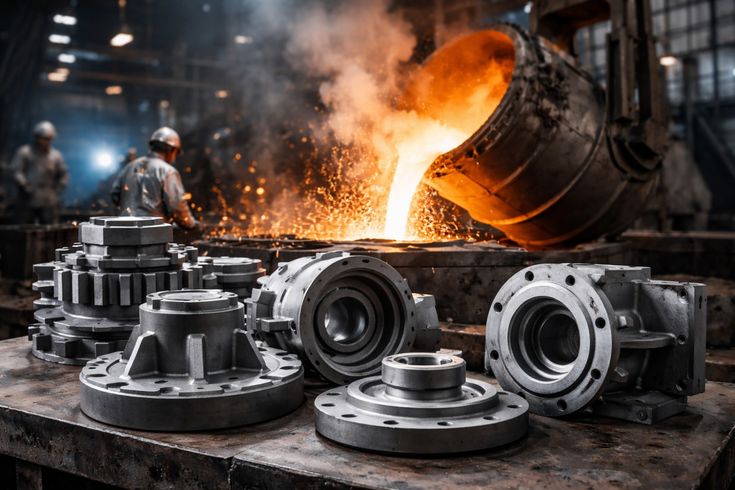
Industrial manufacturers must continually balance component quality, production efficiency, material performance, and cost. Choosing the right manufacturing process matters, especially when components require complex shapes, precise dimensions, or specialised engineering alloys. Investment casting offers several advantages for suitable applications because it can produce intricate metal parts with relatively accurate as-cast dimensions and reduced dependence on extensive material removal. Manufacturers considering this process often weigh design flexibility, tooling requirements, production volume, and finishing operations. Precision casting companies such as Texmo Blank operate in an industry where these considerations shape how they develop and produce metal components for industrial use.
Understanding the Investment Casting Process
Investment casting is a metal manufacturing method that uses a sacrificial wax pattern to create a ceramic mould. The wax pattern represents the required component geometry and is coated with ceramic materials to form a shell. After the shell is prepared, the wax is removed, leaving a cavity into which molten metal is poured.
Once the metal solidifies, the ceramic shell is removed, and the casting undergoes appropriate finishing and inspection. The process is often described as lost-wax casting because the original wax pattern is removed before the metal is introduced. Its ability to reproduce detailed shapes makes it particularly useful for industrial components with complex features.
Greater Design Flexibility
One of investment casting’s most significant advantages is the design freedom it provides. The process can accommodate intricate external geometries, curved profiles, and features that are difficult to produce with conventional machining alone. With appropriate design and tooling, it can also produce certain internal passages and complex shapes.
This flexibility lets engineers design components that better reflect functional requirements rather than being limited by cutting-tool accessibility. However, casting geometry must still account for metal flow, solidification, ceramic shell strength, and practical manufacturing limitations. Early design reviews help ensure that complex features remain suitable for reliable production.
Near-Net-Shape Manufacturing
Investment casting is commonly used for near-net-shape production, meaning the casting is manufactured close to its final required geometry. This reduces the amount of metal that must be removed during subsequent machining, particularly for components with intricate shapes.
The potential benefit is most apparent when an alternative manufacturing method would involve removing substantial material from a solid block or producing several separate components. Nevertheless, investment castings may still require machining, heat treatment, surface finishing, or other operations. The extent of secondary processing depends on the component’s final specifications.
Reduced Material Waste
Material efficiency matters in industrial manufacturing, especially with costly engineering alloys. Processes involving extensive machining may generate substantial quantities of chips or offcuts, even when some of that material can be recovered.
Investment casting can reduce material removal by producing a component closer to its final shape. However, the process’s overall material efficiency also depends on casting yield, gating and feeding systems, rejected parts, and subsequent finishing requirements. Manufacturers should evaluate material use across the full production process rather than considering only the finished casting.
Dimensional Accuracy for Complex Parts
Investment casting can provide useful dimensional accuracy for components with complex geometries. This may reduce the need to machine every external surface and allow designers to preserve intricate features that would otherwise be difficult to reproduce.
However, component dimensions, alloy behaviour, tooling, and process control affect achievable tolerances. Engineers should distinguish between general casting tolerances and critical functional dimensions that require tighter control. Precision machining may still be necessary for bearing locations, threaded features, sealing surfaces, and other important interfaces.
Versatility Across Engineering Alloys
Investment casting can use a range of metals and alloys suitable for industrial applications. Depending on the process and manufacturer, these may include stainless steels, carbon steels, and selected speciality alloys. This versatility lets engineers choose materials based on the mechanical and environmental demands of the finished component.
Material selection should account for strength, corrosion resistance, wear, temperature exposure, and relevant standards. Different alloys also have different casting characteristics, so evaluate material suitability alongside component geometry and production requirements.
Opportunities for Part Consolidation
Some industrial assemblies contain multiple components manufactured separately and then joined. Where engineering requirements allow, investment casting can incorporate several design features into one metal component.
Reducing the number of separate parts may simplify assembly, decrease certain joining operations, and improve inventory management. However, part consolidation can also introduce manufacturing challenges if the resulting geometry becomes excessively complex or difficult to inspect. The decision should be supported by engineering analysis and a clear understanding of production feasibility.
Surface Finish Advantages
Investment casting can produce relatively smooth as-cast surfaces compared with several other casting processes. This may reduce the finishing work required for components where the resulting surface condition is acceptable.
However, not all industrial applications can use an as-cast finish. Components exposed to particular wear conditions, sealing requirements, or corrosion environments may require additional treatment. Manufacturers should specify the required surface characteristics and determine which finishing operations are necessary to achieve them.
Manufacturing Complex Components in Repeatable Production
Once manufacturers establish suitable tooling and production procedures, investment casting can support repeatable manufacturing of complex components. Standardised wax pattern production, ceramic shell preparation, and controlled casting conditions help ensure process consistency.
Repeatability remains dependent on effective quality control and stable production conditions. Inspection procedures should verify that components meet dimensional and material requirements, especially for demanding industrial applications.
Evaluating Cost Effectiveness
Investment casting can be cost-effective when component complexity, material use, and reduced secondary processing justify the initial tooling and manufacturing requirements. It may be especially attractive when conventional methods would require extensive machining or assembly.
However, simple components produced in very large quantities may suit other processes better. Production economics depend on part size, alloy, tooling costs, order quantities, inspection requirements, and finishing operations. Manufacturers should compare complete production costs before selecting a process.
When Investment Casting May Not Be the Best Choice
Despite its advantages, investment casting has limitations. Alternative manufacturing processes may better suit very large components, extremely simple geometries, or applications requiring specific mechanical properties.
The process also involves multiple stages, including tooling, wax pattern production, shell preparation, casting, and finishing. These requirements can influence lead times and production economics. Therefore, selecting investment casting should involve a balanced assessment of technical feasibility, quality requirements, and cost.
Frequently Asked Questions (FAQs) About the Advantages of Investment Casting
What is the main advantage of investment casting?
One key advantage is the ability to produce complex metal geometries with relatively accurate as-cast dimensions. This can reduce secondary machining and support greater design flexibility for suitable components.
Does investment casting reduce production costs?
It can reduce certain costs by limiting machining, material removal, or assembly requirements. However, overall cost depends on tooling, production volume, component complexity, alloy selection, and finishing operations.
Can investment casting produce complex internal features?
Certain internal features can be produced using appropriate cores and tooling. Feasibility depends on the geometry, material, manufacturing process, and ability to remove the core material after casting.
Is investment casting suitable for industrial machinery?
Yes. Investment casting is used for various industrial machinery components where complex geometry, suitable materials, and dimensional accuracy are important. Each application must be assessed individually.
What are the limitations of investment casting?
Limitations may include tooling requirements, production lead times, component size constraints, and the need for secondary machining or inspection. Suitability depends on the intended application and manufacturing requirements.