



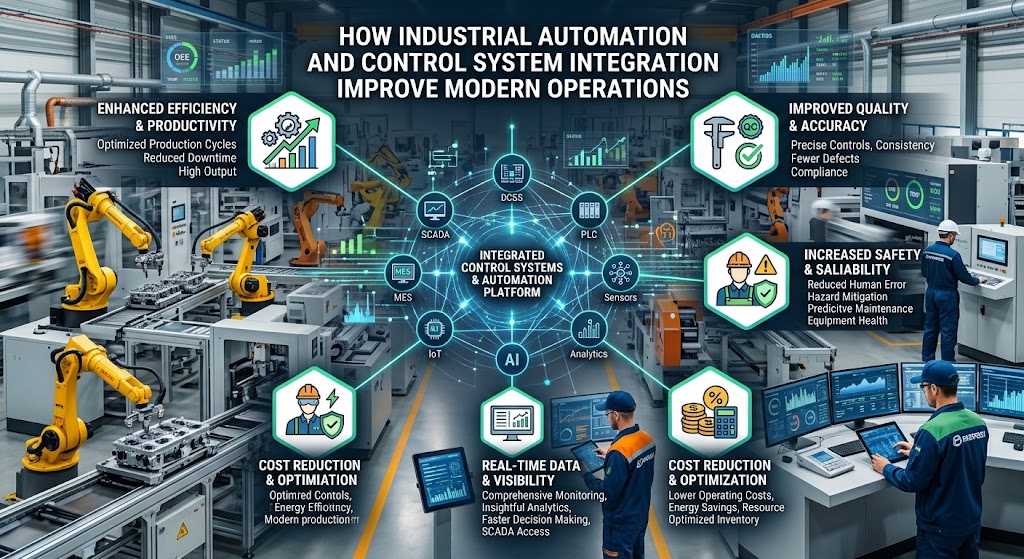
Industrial businesses are under constant pressure to improve efficiency, maintain consistent quality, and keep workers safe while controlling operating costs. This is where control system integration becomes essential, connecting machines, software, sensors, and industrial equipment into a coordinated system that works smoothly. Companies such as Pacific Blue Engineering help businesses implement tailored automation solutions across manufacturing, food and beverage, life sciences, entertainment, and transportation. Through advanced systems engineering and automation technologies, they help organizations optimize processes, modernize legacy controls, improve machine safety, enhance product quality, reduce operational risks, and gain valuable insights into their daily operations.
What Is Industrial Automation and Control System Integration?
Industrial automation involves using technology to operate machinery, monitor processes, and perform repetitive tasks with less manual intervention. Control system integration brings these technologies together so equipment and software can communicate and function as a unified operation.
For example, a manufacturing facility may use sensors to monitor temperature, programmable logic controllers (PLCs) to manage machinery, and a supervisory control and data acquisition (SCADA) system to display real-time information. When these components work together, operators can monitor production, identify potential problems, and make informed decisions without constantly checking individual machines.
The goal is not simply to automate everything. It is to create a reliable, practical system that meets the facility’s needs, supports its employees, and delivers measurable improvements over time.
Why Businesses Are Investing in Industrial Automation
Automation has become increasingly important as industries face changing customer expectations, labor challenges, tighter quality requirements, and growing competition. A well-designed system can address several of these concerns at once.
1. Improving Operational Efficiency
Manual processes can create bottlenecks, inconsistent production times, and unnecessary delays. Automated systems help standardize repetitive tasks, coordinate machinery, and reduce the time spent on routine adjustments.
For instance, an automated production line can synchronize conveyors, filling equipment, packaging machines, and inspection systems. If one part of the process slows down, operators can identify the issue and respond before it affects the entire production schedule.
Better coordination helps businesses use equipment more effectively, reduce downtime, and maintain a more predictable workflow.
2. Modernizing Legacy Control Systems
Many industrial facilities depend on equipment that has been operating reliably for years. However, older controllers, outdated software, and unsupported components can eventually create maintenance challenges and limit access to useful operational data.
Replacing an entire system is not always necessary. In many cases, businesses can upgrade selected components, introduce modern control platforms, improve communication between machines, and connect existing equipment to newer monitoring tools.
A carefully planned modernization project allows companies to preserve valuable assets while addressing outdated technology. It can also make future upgrades easier by creating a more flexible and scalable foundation.
3. Enhancing Product Quality and Consistency
Product quality depends on maintaining the right conditions throughout production. Small variations in temperature, pressure, timing, ingredient quantities, or machine settings can lead to defects and wasted materials.
Automation helps control these variables more precisely. Sensors collect measurements, controllers make adjustments, and inspection systems identify deviations from established standards.
In food and beverage production, for example, automated monitoring can help maintain consistent processing conditions. In life sciences, carefully controlled processes can support repeatability and compliance with applicable quality requirements.
These capabilities help businesses reduce production errors, limit waste, and deliver more consistent results to customers.
The Importance of Machine Safety in Automated Facilities
Automation can improve workplace safety, but introducing machinery and automated processes also creates risks that must be carefully managed. Moving equipment, robotic arms, conveyors, and unexpected machine startups can expose workers to serious hazards if appropriate safeguards are missing.
This is why machine safety services are an important part of industrial engineering and automation projects.
These services may include machinery risk assessments, safety control design, protective guarding, emergency-stop systems, safety interlocks, and the integration of safety-rated controllers. The specific measures depend on the equipment, operating environment, applicable regulations, and identified hazards.
Building Safety Into the System
Safety should be considered from the beginning of an automation project rather than added as an afterthought. Engineers need to understand how employees interact with machinery, how equipment behaves during faults, and what happens when a system starts, stops, or requires maintenance.
A properly designed safety system can help prevent hazardous movement, stop equipment under defined conditions, and reduce the likelihood of accidental exposure to dangerous machinery.
However, installing safety equipment alone is not enough. Businesses also need appropriate procedures, employee training, regular inspections, and maintenance.
By combining thoughtful engineering with effective safety practices, industrial facilities can protect workers while maintaining productive operations.
How Control Systems Provide Better Operational Insights
One of the biggest advantages of modern automation is the ability to collect and use operational data. In traditional facilities, important information may be scattered across separate machines, handwritten logs, and disconnected software systems.
Integrated systems can bring this information together in a central location, giving operators and managers a clearer picture of what is happening across the facility.
Useful information may include:
-
Production output: How many units are being produced during a shift.
-
Equipment performance: Which machines are running efficiently and which are experiencing repeated problems.
-
Energy consumption: Where electricity or other resources are being used unnecessarily.
-
Process conditions: Whether temperature, pressure, flow, or other variables remain within required limits.
-
Downtime patterns: How frequently equipment stops and what may be causing those interruptions.
-
Maintenance needs: Whether equipment behavior suggests a developing fault.
With access to reliable data, businesses can move beyond reacting to problems after they occur. They can investigate recurring issues, identify opportunities for improvement, and make decisions based on actual operating conditions.
The Role of a Control System Integrator
Industrial automation projects often involve equipment from multiple manufacturers, different communication protocols, and software platforms with varying capabilities. Bringing these components together requires more than installing hardware and configuring individual devices.
A control system integrator evaluates the existing operation, identifies business requirements, develops a suitable design, and coordinates the technologies needed to achieve the desired outcome.
A typical project may involve several stages:
-
Assessment and planning: Understanding current processes, operational challenges, equipment limitations, and business objectives.
-
System design: Selecting suitable controllers, instrumentation, software, networking components, and safety measures.
-
Integration and programming: Configuring devices and developing the logic that allows equipment and systems to work together.
-
Testing and commissioning: Verifying functionality, checking safety requirements, and confirming that the system performs as intended.
-
Training and support: Helping employees understand the new system and providing a foundation for ongoing maintenance and improvements.
Working with an experienced integrator can help businesses avoid compatibility problems, reduce implementation risks, and develop solutions that reflect their actual operational needs.
Industries That Benefit From Industrial Automation
Although the underlying technologies may be similar, every industry has its own priorities and challenges.
Manufacturing
Manufacturers use automation to coordinate production lines, operate machinery, monitor equipment performance, and improve consistency. Integrated controls can also help identify bottlenecks and reduce unplanned downtime.
Food and Beverage
Food and beverage facilities often require precise control over mixing, processing, filling, packaging, and cleaning operations. Automation helps maintain consistent conditions, improve traceability, and support applicable hygiene and quality requirements.
Life Sciences
Life sciences operations may require tightly controlled environments, repeatable processes, detailed records, and careful monitoring. Automation can support these needs when systems are designed and validated according to the relevant industry requirements.
Entertainment
Automation also plays a role in entertainment venues, attractions, and specialized installations. Integrated control systems can coordinate equipment, lighting, motion, and other technical elements while incorporating appropriate operational safeguards.
Transportation
Transportation-related facilities can use automation to coordinate equipment, monitor infrastructure, and improve the reliability of complex operations. Depending on the application, integrated controls may support material handling, facility management, and specialized transport systems.
Across these industries, successful automation depends on understanding the specific process rather than applying the same design to every facility.
Common Challenges in Automation Projects
Despite its benefits, industrial automation requires careful planning. Poorly managed projects can create unexpected costs, operational disruptions, and systems that fail to meet business expectations.
One common challenge is integrating old and new equipment. Legacy machines may use outdated communication methods or have limited documentation, making compatibility difficult to establish.
Another concern is unplanned downtime during implementation. Upgrades must often take place while a facility continues operating, so installation, testing, and commissioning need to be coordinated carefully.
Businesses must also consider cybersecurity, employee training, spare parts, long-term maintenance, and the availability of technical support.
The best way to address these challenges is to define clear project requirements, assess risks early, test changes thoroughly, and involve the people who will operate and maintain the system.
Choosing the Right Automation Solution for Your Business
Not every facility needs a complete automation overhaul. Some businesses may benefit most from upgrading an outdated PLC, while others may need integrated monitoring, improved machine safeguards, or a more comprehensive control system redesign.
Before starting a project, consider the following questions:
-
Which processes consume the most time or resources?
-
Where do production errors or equipment failures occur most frequently?
-
Are existing control systems difficult to maintain or expand?
-
Can operators access the information they need to make timely decisions?
-
Do current machinery safeguards adequately address identified risks?
-
Will the proposed solution support future production requirements?
Answering these questions helps establish priorities and prevents businesses from investing in technology that does not address their actual problems.
It is also worth considering the full lifecycle cost of a system, including installation, training, maintenance, upgrades, and technical support. A solution that is easy to maintain and expand may provide greater long-term value than one selected solely on its initial price.
Conclusion
Industrial automation is about more than making machines operate automatically. It is about creating safer, more connected, and more efficient operations where equipment, software, and people work together effectively.
Through thoughtful control system integration, businesses can modernize aging equipment, improve product consistency, reduce avoidable downtime, and gain better visibility into their processes. Combining these improvements with appropriate machine safety services helps organizations manage workplace hazards while supporting reliable production.
With a clear understanding of operational needs and support from experienced engineering professionals, businesses can approach automation as a long-term investment in productivity, quality, and operational resilience. The most successful projects are those that solve real problems today while leaving room for tomorrow’s opportunities.