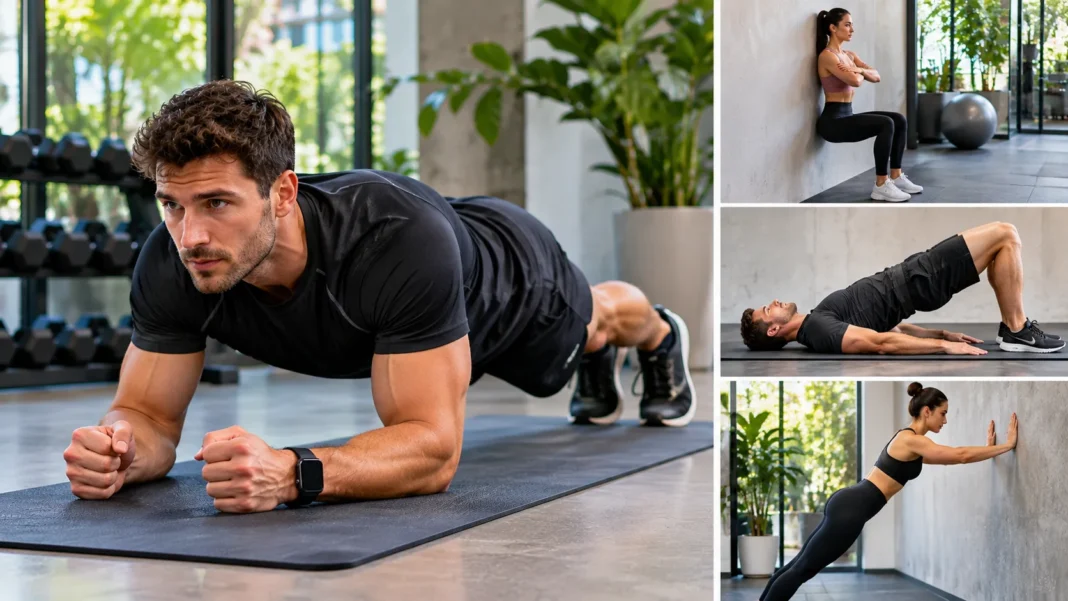
What Is Isometric Exercise?
Isometric exercise is a type of strength training in which muscles contract without noticeably changing length or moving the involved joints. Instead of repeatedly lifting and lowering weights, you maintain a position or apply force against resistance. Common examples include planks, wall sits, and static holds. These exercises can improve muscular strength, endurance, and control when performed appropriately.
The word isometric comes from terms meaning equal or unchanged length. During an isometric contraction, muscles generate tension while the joint remains relatively stationary. This differs from dynamic exercises, where muscles produce movement through a range of motion. Understanding what isometric exercise means can help beginners recognize its role in different fitness routines.
Isometric exercises are used in general fitness, sports conditioning, and certain rehabilitation programs. They can target specific muscle groups while limiting joint movement during the exercise. However, reduced movement does not automatically make every isometric exercise safe for every condition. Proper technique, comfortable breathing, and suitable intensity are essential for effective training.
How Does Isometric Exercise Work?
Isometric exercise works by creating muscle tension without producing visible movement at the target joint. The nervous system activates muscle fibers to generate force against an external load or a fixed position. Because the joint remains relatively stable, the exercise challenges muscular control in a specific position. The amount of effort depends on the resistance and duration.
For example, holding a plank requires the abdominal, shoulder, and hip muscles to maintain a stable body position. Although the body appears motionless, several muscles actively generate force to resist gravity. A wall sit works similarly by challenging the lower-body muscles while the knees remain bent. These exercises demonstrate how strength training can occur without repeated movement.
Isometric training produces adaptations that depend on exercise intensity, joint angle, and training frequency. Strength improvements are often greatest near the positions used during training, although some benefits can transfer to other angles. This makes isometric holds useful alongside traditional resistance exercises. A balanced program can include both static and dynamic movements for broader physical development.
Isometric vs Isotonic Exercise: What’s the Difference?
Isometric and isotonic exercises are two common forms of muscular training. Isometric contractions create force without noticeable joint movement, while isotonic exercises involve muscles shortening or lengthening as the body moves. Holding a squat position is an isometric activity. Performing repeated squats involves dynamic contractions through a range of motion.
During a biceps curl, the elbow bends as the weight moves upward and straightens as it returns downward. These movements involve concentric and eccentric muscle actions. In contrast, holding a weight at a fixed elbow angle challenges the muscles isometrically. Both approaches can improve strength, but they create different training demands.
Neither exercise type is universally better than the other. Dynamic exercises develop strength through movement, while isometric holds emphasize force production and control at particular positions. Combining both methods can support balanced training. The appropriate choice depends on personal goals, physical ability, available equipment, and any relevant medical considerations.
Key Benefits of Isometric Exercise
One important benefit of isometric exercise is its ability to improve muscle strength without requiring repeated joint movement. Holding a position challenges muscles to maintain tension against resistance. This can be useful for beginners and experienced exercisers alike. Strength improvements depend on the difficulty of the hold and whether the exercise becomes progressively more challenging.
Isometric training can also improve muscular endurance for specific positions. Exercises such as wall sits and planks challenge muscles to maintain force over time. These abilities may support certain sports and everyday tasks. However, longer holds are not automatically better, and training quality matters more than trying to maintain uncomfortable positions.
Another advantage is convenience. Many isometric exercises require little equipment and can be performed in relatively small spaces. This makes them practical additions to home workouts and structured fitness programs. However, some high-intensity holds can sharply increase blood pressure, so people with cardiovascular concerns should seek medical guidance before attempting demanding variations.
How Isometric Exercises Build Muscle Strength
Muscles become stronger when training provides an appropriate challenge followed by sufficient recovery. Isometric exercise creates this challenge through sustained muscular contractions. When performed with suitable intensity and progression, these contractions can stimulate strength adaptations. Results depend on factors such as training experience, hold duration, effort, and consistency.
A beginner may find a short wall sit challenging because the leg muscles must support the body’s position. As strength improves, the same hold may become easier. Increasing resistance or adjusting the position can provide a new challenge. However, exercise progression should remain gradual and should not require pushing through significant pain.
Isometric exercises can also contribute to muscle growth under appropriate training conditions. However, they are not guaranteed to produce the same adaptations as every dynamic resistance exercise. Training through different movement ranges may provide broader benefits for many goals. Combining static holds with controlled dynamic strengthening can create a more complete fitness routine.
Isometric Exercise for Core Strength and Stability
Core strength is one of the most familiar applications of isometric training. The abdominal and back muscles often work to maintain trunk position during movement. Isometric core exercises challenge these muscles to resist unwanted motion. Planks, side planks, and modified stability holds are common examples used in general fitness programs.
A standard plank involves maintaining a stable position while supporting the body through the forearms and feet. The abdominal muscles, shoulders, and hips work together to resist gravity. Beginners can reduce difficulty by supporting their knees or using an elevated surface. Maintaining comfortable breathing is more important than holding the position for an excessive duration.
Side planks emphasize muscles that resist sideways trunk movement. They challenge the obliques alongside muscles around the hips and shoulders. Bent-knee variations can make the exercise more manageable. These holds may improve strength and endurance, but they are most useful when included within a balanced program involving different movement patterns.
Wall Sit: A Simple Isometric Exercise for Legs
The wall sit is a familiar isometric exercise that targets the quadriceps and other lower-body muscles. It involves maintaining a seated-like position while the back rests against a wall. The legs generate force to hold the body in place. This exercise can develop muscular endurance and strength when performed at an appropriate difficulty.
To begin, stand with your back against a stable wall and position your feet comfortably forward. Slowly bend your knees and slide downward to a manageable depth. Keep your feet supported and avoid forcing the knees into an uncomfortable angle. Hold briefly while breathing normally, then return to standing in a controlled manner.
Beginners can start with a shallow wall sit rather than lowering into a deep position. Short holds may be sufficient when the exercise is unfamiliar. As control improves, the position or duration can be adjusted gradually. Stop if you experience sharp knee pain, dizziness, or unusual discomfort rather than trying to complete a predetermined hold.
Plank Exercise: Proper Form and Common Mistakes
The plank is a popular isometric exercise used to develop trunk strength and muscular endurance. It requires the body to resist sagging or excessive arching while maintaining support through the arms and legs. Several muscle groups contribute to the position. Proper form should emphasize stability and comfortable breathing rather than an unusually long hold.
Begin with your forearms supported on the floor and your elbows positioned approximately beneath your shoulders. Extend your legs behind you or keep your knees supported for an easier variation. Maintain a comfortable trunk position without deliberately forcing the spine into an extreme shape. Breathe steadily throughout the exercise.
Common plank mistakes include holding the breath, raising the hips excessively, and continuing after control has noticeably deteriorated. These habits may reduce exercise quality or create unnecessary strain. Short, well-controlled repetitions can be more useful than one extended hold. Choose a variation that matches your current strength and movement abilities.
Glute Bridge Hold for Hip Strength
The glute bridge hold is an isometric exercise that challenges muscles around the hips and trunk. It primarily involves the gluteal muscles while also requiring support from the hamstrings and abdominal muscles. The exercise can be performed on a comfortable floor surface. It is commonly included in general strengthening and certain rehabilitation programs.
Start by lying on your back with your knees bent and feet resting on the floor. Gently lift your hips until you reach a comfortable position, then maintain the hold briefly. Avoid forcing the lower back into excessive extension. Lower your hips slowly and allow your muscles to relax between repetitions.
A beginner can use short holds and gradually increase the challenge when comfortable. The exercise should create manageable muscular effort rather than sharp back or hip pain. Different foot positions can change how the movement feels. People recovering from injuries may benefit from professional guidance to select an appropriate range and intensity.
Isometric Exercises for the Upper Body
Isometric training can also target the shoulders, arms, chest, and upper back. These exercises involve maintaining resistance without repeated joint movement. Examples include holding a light weight at a fixed position or applying controlled pressure against a stable surface. The difficulty depends on the amount of force generated and the position maintained.
An isometric biceps hold involves keeping the elbow bent while supporting a suitable weight. The biceps muscles generate force to maintain the position. Similarly, an appropriately modified push-up hold can challenge the chest, shoulders, and arms. Beginners should select variations that allow stable positioning and comfortable breathing.
Upper-body isometric training can complement traditional exercises such as rows and presses. However, holding heavy weights for extended periods may create unnecessary strain. Start with manageable resistance and focus on controlled muscular engagement. People with shoulder, elbow, or wrist pain should consider an assessment before attempting exercises that provoke symptoms.
Isometric Exercises for Knee Strength
Isometric exercises are sometimes used to strengthen muscles supporting the knee. Quadriceps contractions, straight-leg holds, and certain supported positions can provide muscular loading with limited joint movement. These exercises may be useful in selected rehabilitation programs. However, the best approach depends on the cause of symptoms and the individual’s physical condition.
A basic quadriceps set involves sitting or lying with the leg comfortably supported. Gently tighten the front thigh muscles while keeping the leg relatively still. Hold the contraction briefly, then relax. The exercise can help develop awareness of quadriceps activation without requiring repeated bending of the knee.
Knee rehabilitation should be guided by the specific injury or medical condition. Some people tolerate isometric exercises comfortably, while others require different loading strategies. Significant swelling, instability, or persistent pain warrants professional assessment. A physical therapist can recommend appropriate exercises and progression based on individual recovery needs.
Isometric Exercise for Rehabilitation and Recovery
Isometric exercise is frequently included in physical rehabilitation because it allows muscles to generate force with limited joint movement. This can be useful when certain movements are uncomfortable or temporarily restricted. However, the benefits depend on the injury and stage of recovery. Not every condition responds best to static contractions.
Physical therapists may use isometric exercises to maintain or rebuild muscle function during recovery. For example, controlled contractions can be part of rehabilitation for selected tendon or joint conditions. Exercise intensity and duration are adjusted according to symptoms and treatment goals. Some programs later introduce dynamic strengthening as movement tolerance improves.
Rehabilitation should not rely entirely on one exercise method without considering the broader problem. Restoring comfortable function may require mobility, strength, balance, and task-specific training. Isometric exercises can contribute to this process but are not a universal treatment. Individual assessment helps determine when static holds are appropriate and how they should progress.
Can Isometric Exercise Help With Joint Pain?
Isometric exercises may help some people maintain strength when joint movement is uncomfortable. Because the joint remains relatively stationary, certain positions can feel more manageable than repeated movement. However, muscle contractions still place forces through joints and surrounding tissues. The absence of visible movement does not mean an exercise is completely stress-free.
Some rehabilitation programs use isometric contractions to manage tendon-related symptoms or maintain muscle capacity. Research findings on immediate pain relief are mixed, and responses vary between individuals. Therefore, an isometric exercise should not be presented as a guaranteed pain-relief method. Appropriate loading depends on the condition and symptom response.
People experiencing persistent joint pain should seek guidance before relying on a particular exercise routine. A clinician can help identify whether isometric training is suitable or whether other treatment is needed. Exercises should remain within an individually appropriate tolerance. Worsening pain, significant swelling, or sudden loss of function requires further assessment.
How Long Should You Hold an Isometric Exercise?
The ideal duration of an isometric hold depends on the exercise, intensity, and training goal. Beginners may start with holds lasting approximately five to fifteen seconds when comfortable. Some endurance-focused exercises use longer durations. However, a short high-effort contraction can be more demanding than a longer hold performed with lighter resistance.
Hold duration should allow you to maintain appropriate technique and steady breathing. If your position changes significantly or you experience unusual discomfort, the exercise may be too challenging. Rest between repetitions allows muscles to recover. Gradually increasing difficulty is generally more useful than immediately attempting the longest possible hold.
Different exercises require different approaches. A gentle rehabilitation contraction may use brief holds, while a plank or wall sit may involve longer intervals. There is no single duration that suits everyone. Training should be adjusted according to ability, health considerations, and the desired physical adaptation.
How Often Should You Perform Isometric Exercises?
Isometric exercises can be included in a regular strength-training program alongside dynamic movements. The appropriate frequency depends on exercise intensity, muscle groups involved, and recovery needs. General strengthening sessions may include static holds several times per week. However, demanding contractions should be balanced with sufficient recovery.
Beginners can start with a small number of controlled repetitions during suitable exercise sessions. As strength improves, they may gradually adjust resistance, hold duration, or training volume. Progress should be based on comfortable performance rather than strict deadlines. Consistency over time matters more than completing difficult exercises every day.
People using isometric training for rehabilitation may follow a different schedule. Certain programs involve more frequent low-intensity contractions, while others require greater recovery between sessions. A healthcare professional can provide individualized recommendations. The most practical routine is one that supports progress without repeatedly aggravating symptoms.
Isometric Exercise and Blood Pressure
Isometric exercise can produce a temporary increase in blood pressure during muscular contraction. The size of this response depends on the effort, duration, muscle mass involved, and breathing pattern. High-intensity holds may create substantial cardiovascular demands. This is particularly important for people with uncontrolled hypertension or certain heart conditions.
Some research suggests that appropriately prescribed isometric resistance training may help reduce resting blood pressure over time. However, this does not mean every static hold is suitable for people with high blood pressure. Training protocols vary, and individual medical circumstances matter. Isometric exercise should not replace prescribed medication or professional cardiovascular care.
Avoid holding your breath during demanding exercises because breath-holding can increase pressure responses. People with cardiovascular conditions should seek medical advice before beginning intense isometric training. Lower-intensity alternatives may be appropriate in certain circumstances. Safe exercise choices depend on medical history, current health status, and professional recommendations.
Common Isometric Exercise Mistakes to Avoid
One common mistake is holding the breath while maintaining muscle tension. Some people unintentionally stop breathing when an exercise becomes difficult. This can increase cardiovascular strain and make the activity less comfortable. Breathing steadily helps maintain control and supports a more manageable exercise experience.
Another mistake involves choosing an exercise that is too difficult for the current fitness level. Attempting a deep wall sit or demanding plank without sufficient preparation can create excessive fatigue. Beginners should start with manageable positions and gradually increase the challenge. Proper technique is more important than comparing hold times with other people.
Finally, avoid assuming isometric exercise can replace every other form of physical activity. Static holds develop useful muscular abilities but do not provide all the benefits of movement-based training. A balanced program may include walking, resistance exercises, mobility activities, and appropriate aerobic exercise. Combining different methods supports broader physical function and fitness.
How to Include Isometric Exercises in Your Workout
Adding isometric exercises to a fitness routine does not require complicated equipment. Beginners can choose simple movements such as modified planks, wall sits, and glute bridge holds. These exercises target different muscle groups and can be adjusted for difficulty. Start with comfortable positions that allow controlled breathing and stable technique.
Isometric holds can be performed as part of a warm-up, strength session, or targeted rehabilitation plan. Their placement depends on training goals and exercise intensity. Short, moderate holds may help practice movement control, while demanding contractions are better treated as strength work. Avoid exhausting the muscles before activities that require precise coordination.
A balanced workout should also include movements through comfortable ranges of motion. Squats, rows, walking, and other suitable exercises can complement static training. Progress gradually and allow appropriate recovery between challenging sessions. This approach helps make isometric exercise a useful component of overall physical activity rather than the only training method.
Conclusion
Isometric exercise is a form of strength training that creates muscular tension without noticeable joint movement. Common examples include planks, wall sits, glute bridge holds, and static resistance exercises. These movements can develop strength, endurance, and muscular control. Understanding how isometric contractions work helps explain their role in fitness and rehabilitation.
The benefits of isometric training depend on exercise selection, intensity, technique, and individual circumstances. Static holds can be convenient because many require minimal equipment. However, they should be performed with comfortable breathing and appropriate progression. People with certain medical conditions or persistent pain may need professional guidance before attempting demanding exercises.
A practical fitness routine combines isometric exercises with other forms of strength and movement training. Beginners can start with manageable holds and gradually develop confidence and muscular capacity. Consistent practice and sufficient recovery support progress over time. When performed appropriately, isometric exercises can contribute to a balanced approach to physical fitness and everyday movement.
Frequently Asked Questions
What is isometric exercise in simple terms?
Isometric exercise involves tightening a muscle without noticeably moving the joint. Examples include holding a plank, maintaining a wall sit, or keeping a weight in a fixed position.
What are the main benefits of isometric exercise?
Isometric exercises can improve muscle strength, endurance, and movement control. They also require minimal equipment in many cases and can support certain rehabilitation programs when appropriately prescribed.
Is a plank an isometric exercise?
Yes, a plank is an isometric exercise because the trunk muscles generate force while the body maintains a relatively stable position. It challenges abdominal, shoulder, and hip muscles.
Can isometric exercises build muscle?
Yes, appropriately challenging isometric training can contribute to muscle growth and strength development. However, results depend on intensity, progression, recovery, and the overall exercise program.
How long should beginners hold an isometric exercise?
Beginners may start with comfortable holds of approximately five to fifteen seconds, depending on the exercise. The correct duration should allow steady breathing, stable technique, and manageable muscular effort.